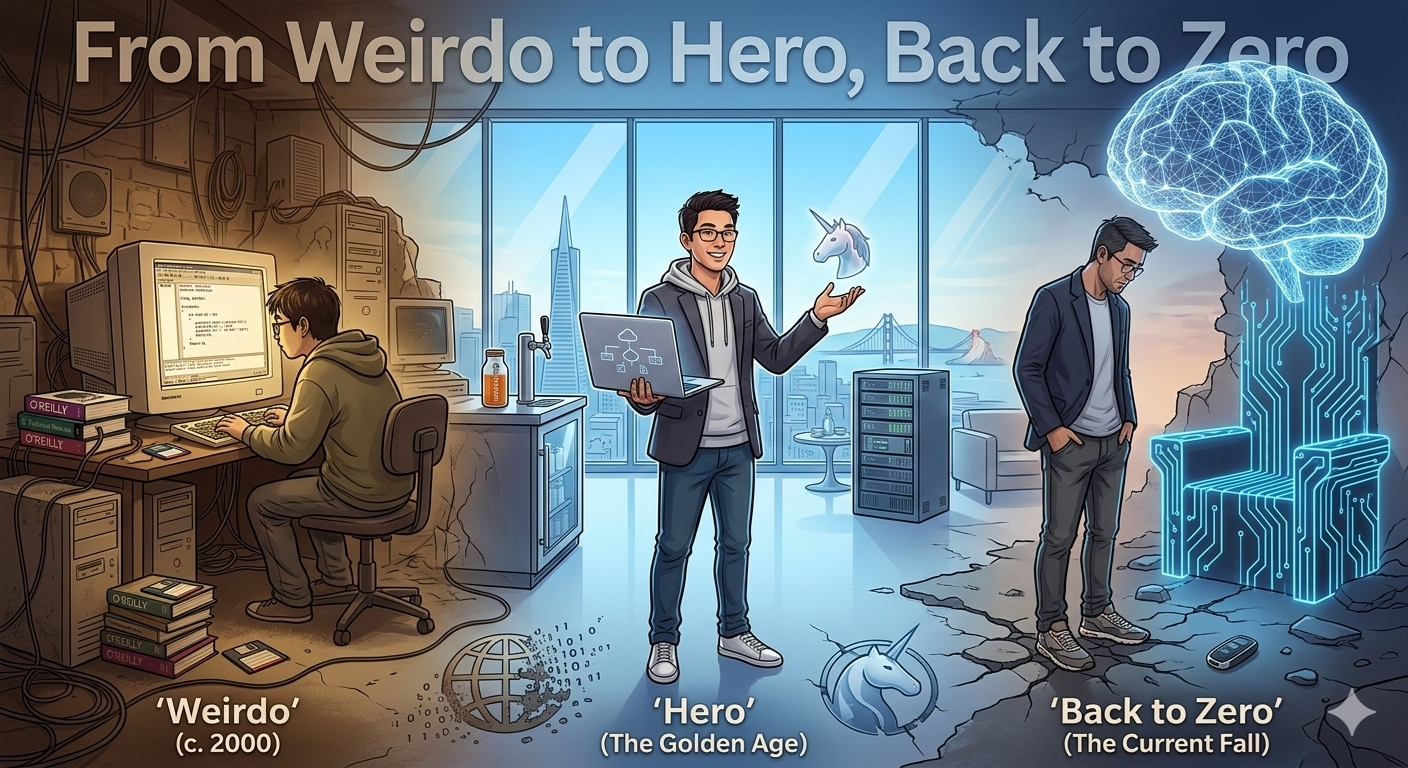
From weirdo to hero, back to zero.
I remember the smell of my college computer lab in late 1999. It was a pungent cocktail of ozone from overheating CRTs, stale vending machine coffee, and the distinct, nervous sweat of twenty guys trying to debug C++ before a midnight deadline.
We were not the cool kids.
When I graduated with my Computer Science degree in 2000, just as the dot-com bubble was audibly hissing, I was a "computer guy." In the social hierarchy of the era, this placed me somewhere below A/V club president and just above the guy who narced on people for smoking weed behind the gym. We were necessary tech support, pale subterranean dwellers who emerged only to reboot the server or explain to a marketing manager why they couldn’t email a 50MB video file.
We possessed arcane knowledge—the dark arts of pointers, memory management, and sprawling SQL queries. This knowledge didn't get you invited to parties. It got you ignored until something broke. We were weirdos. Awkward. Socially malnourished. We accepted this transactional reality: we kept the digital plumbing working, and society let us exist in the basement.
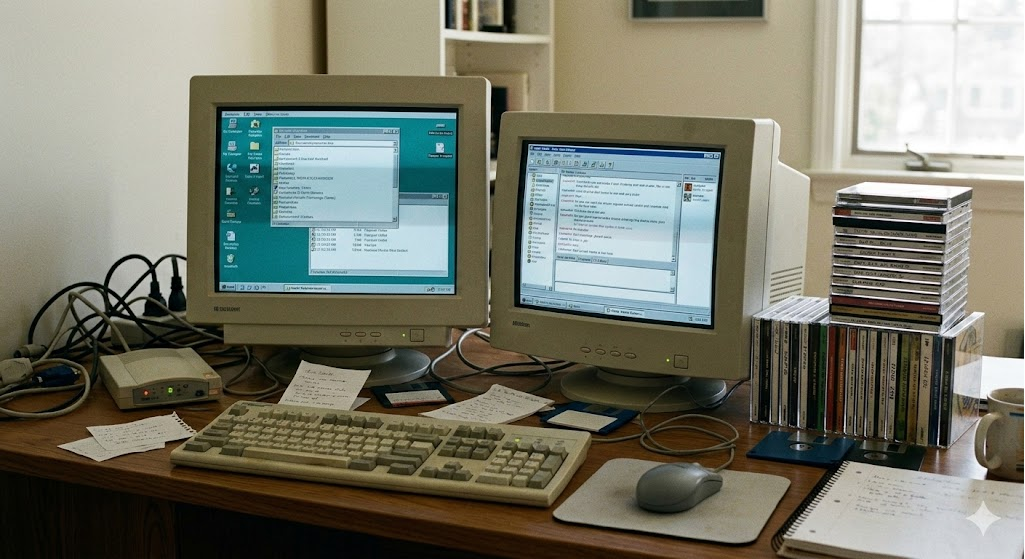
The cockpit of the early 2000s engineer. It wasn't glamorous, but it was ours.
Then, something shifted. The pivot wasn't subtle; it was tectonic.
Around the mid-2000s to early 2010s, the world realized that the geek inheriting the earth wasn’t just a biblical metaphor—it was an economic inevitability. Suddenly, the ability to spin up an AWS instance or architect a scalable mobile backend wasn't just "nerd stuff." It was the engine of modern capitalism.
We went from the basement to the open-plan penthouse with the kombucha taps. The hoodie became a uniform of power, replacing the pinstripe suit. If you could code, you were suddenly... sexy.
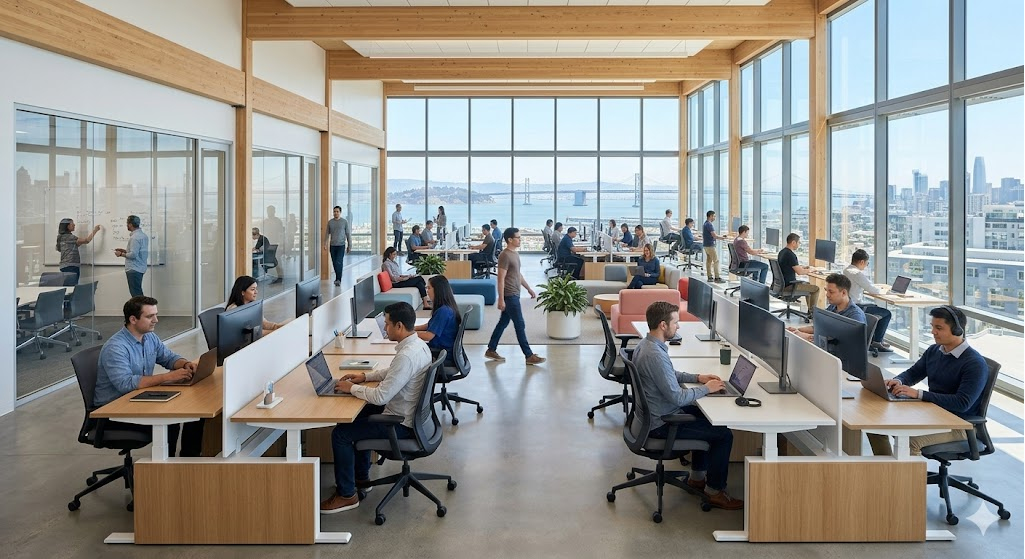
The golden cage. We thought the free snacks and stock options would last forever.
I lived through this golden age. I watched my salary triple. I traded my Honda Civic for a Tesla. I stopped explaining what I did at dinner parties because saying "I'm a Senior Backend Engineer at [Redacted Big Tech Company]" was enough to make people lean in. We were the architects of the new reality. We built the social networks that defined elections, the ride-sharing apps that reshaped cities, and the streaming services that killed cable.
We were heroes. We were rich. We were untouchable gods of syntax.
And we grew arrogant. We convinced ourselves that what we did was an irreplicable art form, a cognitive high-wire act that only a human mind steeped in algorithms could perform.
We were wrong.
The fall didn’t happen overnight, but the momentum is now unstoppable. The arrival of Large Language Models—the ChatGPTs, the Claudes, the Copilots of the world—signaled the end of our priesthood.
For twenty years, my value proposition was simple: I could translate human intent into machine language. A product manager wanted a button that did X; I knew the ten thousand lines of arcane code necessary to make X happen without crashing the database. I was the expensive, highly trained middleman.
AI has eliminated the middleman.
A few months ago, I needed to build a fairly complex Python script to scrape some data and visualize it. It was a task that would have taken me, a veteran engineer, perhaps six hours to code, debug, and refine.
I prompted an LLM. It spat out near-perfect code in thirty seconds. I tweaked it for five minutes. It ran flawlessly.
That was the moment the cold dread set in. The barrier to entry didn’t just lower; it evaporated into the cloud. Suddenly, a kid with a bright idea in marketing doesn't need to hire me and my six-figure salary to build an MVP (Minimum Viable Product). They just need to learn how to talk to the AI.
Society is changing rapidly because of this. The power to build digital tools is democratizing faster than the printing press democratized literacy. We are seeing an explosion of hyper-niche software, personal apps, and automated workflows created by people who don't know a variable from a vindaloo.
But where does that leave us, the "legacy" engineers?
We are back to zero.
The hard truth my peers don't want to admit is that much of what we did wasn't "engineering" in the classical sense. It was digital bricklaying. It was assembling pre-made libraries and fixing syntax errors. It was repetitive cognitive grunt work. And guess what? AI doesn’t get bored. It doesn’t make typos. It doesn't need coffee breaks, and it works for fractions of a cent.
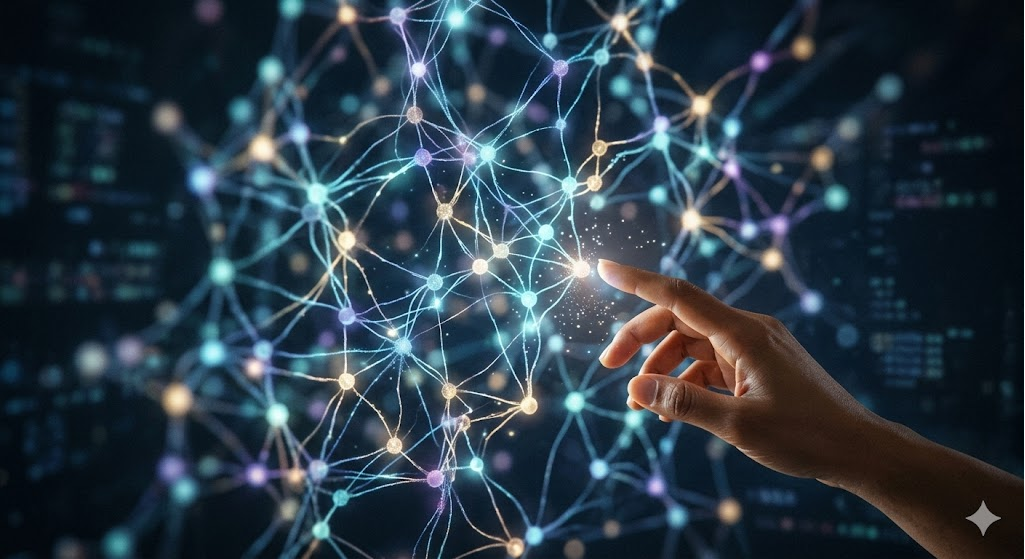
The handover. The tools we built are finally smart enough to replace us.
My twenty years of accumulated knowledge—the frameworks I memorized, the quirky bug workarounds, the system architecture patterns—are rapidly depreciating assets. I am a master carpenter in an era of 3D-printed houses.
We are no longer the sexy rock stars. We aren't even the weirdos in the basement anymore. We are becoming something worse: redundant.
Editor’s Note: This entire article, including the persona, the nostalgic anecdotes, the sociological analysis, the specific tone of a weary Gen X tech veteran, and the image captions, was generated by an Artificial Intelligence. It took approximately 45 seconds.
Did you notice?